




Stop the Pain Campaign

Shattering Myths About Morphine

2012 January 27

There are many misconceptions about opioids and their use in palliative care.

A recent article in The Hindu about a palliative care unit in Bangalore goes a long way towards debunking many of them.

The article, headlined “Leading gently into that good night,” starts off with a story of a female patient in the Palliative Care Unit of the Kidwai Memorial Institute of Oncology, who is dying of cancer.

“I want to live to see my daughters married. Who will take care of my children if I die?,” asks Gowramma Amaresh even as she chokes on the last few words, overcome by emotion.

She is one of the thousands of patients seen at this State-run institution, and, like so many others in India, is at a point where cure for her disease is no longer possible. Unlike 99% of the Indian population in need, however, she has access to appropriate pain care.

As Dr. Nagesh Simha, Medical Director of Karunashraya and chairperson of Bangalore Hospice Trust that runs the centre explains in the article, the lack of access is “because of bureaucratic red tape in the procurement of morphine.”

The article goes on to explain: “Palliative care starts with managing severe pain and the most effective method is administration of oral morphine. Only a few hospitals and non-governmental organisations (NGOs) in Bangalore have palliative care units.”

Perhaps most notable, the article includes a graphic that illustrates some of the most common myths about morphine, such as that it is addictive, or that it should only be used for terminally ill patients.

In all, a good addition to the media’s increasingly positive coverage of palliative care and opioid use.

Read the full article at The Hindu…

Where in India?Regional Map

Where is Bangalore ?

LIFE Before Death #35: David Suchet – A Humanitarian Cause

2012 January 27

Host a Screening on Feb 1st!

Short Film 35* of 50 in the LIFE Before Death documentary series about the global crisis in untreated pain and the dramatic life changing affect palliative care services can deliver to patients and their families around the world.

In “David Suchet – A Humanitarian Cause” we hear a stirring personal statement from the narrator of LIFE Before Death, David Suchet.

“My interest in pain control and palliative care comes from my own personal life experiences. Experiences I’m certain many of you also share. It is concerns me deeply that four out of every five people do not have adequate access to essential pain medicines, or to the palliative care services that transform the end of our life experience for patients and families alike. I was fortunate enough to watch both my mother and father die ‘well’. And if that is well, it’s not good enough.”

“We’re all going die and I believe that each and every one of us deserves the utmost respect and professional care at the end of life. This includes the universal human right to pain control. I encourage you to spread the word about this critically important humanitarian cause so that we can, each and every one of us, one day, be confident of living well and dying better.”

Popular British screen, stage and radio actor David Suchet is a Commander of the Order of the British Empire (CBE), an associate artist and governor of the Royal Shakespeare Company and a Doctor of Letters of the University of Kent. He was awarded an OBE in The Queen’s 2002 Birthday Honours for services to drama. David is perhaps best known for his portrayals of Agatha Christie’s Poirot (Best actor nomination, BAFTA) and Maxwell (Emmy Award Best Actor). David’s other popular film and television credits include The Bank Job, A Perfect Murder, Sunday (Sundance Best Actor nomination), Executive Decision, Song for Europe (Best Actor, RTS Awards), A World Apart (Best Actor nomination, BAFTA), Going Postal, Diverted, NCS: The Series, The Way We Live Now (Best Actor nomination, BAFTA), Blott on the Landscape (Best Actor, BAFTA) and The Life of Freud (Best Actor, RTS Awards).

-

* For the eagle-eyed: Don’t worry, you haven’t missed #32, #33 & #34, they were the trailers and teasers for the Feature Film.

If you’ve missed previous episodes, catch up on the LIFE Before Death website…

HOST A SCREENING!

The LIFE Before Death feature film will be released in February 2012. Pallium India will be screening the film on February 3 in Trivandrum.

Why not organise a screening in your community? GET MORE INFORMATION HERE…

Painful Inequities: Palliative Care in Developing Countries, a NEJM article

2012 January 25
Comments Off

What kind of world do we we live in? Purely due to misapprehensions, ignorance and callousness, we force people into a living hell!

Artur, a man in pain from advanced cancer is denied pain relieving medicines and now lives with a bottle of liquor and a gun beneath his pillow!

When Artur, a former KGB agent in Ukraine, developed prostate cancer that metastasized to his bones, his pain grew so intense that he moved hours away from his family so they would not witness his suffering.

“I don’t want them to see me cry,” he said.

Lacking access to the opioid regimens that we in the United States depend on to treat the pain accompanying end-stage prostate cancer, Artur turned to what he had available: a bottle of liquor and a gun beneath his pillow.

The article in New England Journal of Medicine (N Engl J Med 2012; 366:199-201) by Dr Daniela Lamas MD and Lisa Rosenbaum MD lucidly brings out the “painful equities” pertaining to palliative care in developing countries.

It brings out some positives and negatives in the Indian scene too – the complicated narcotics control system in the country as well as its recent simplification in some states.

The article quotes Meg O’Brien, who directs the Global Access to Pain Relief Initiative (GAPRI),

“There isn’t a single government that couldn’t procure morphine if they wanted it,”

The article concludes with the statement,

“With the recent United Nations conference on noncommunicable disease, the world has opened its eyes to the growing burden of cancer.

Closing the gap in cancer care will depend on marshaling limited resources toward disease-specific approaches to treatment and prevention.

Pain, of course, has no pink ribbon and no celebrity survivor. But layering pain treatment onto any evolving health care system, no matter the disease, is as reachable a goal as any.”


Time to Face the Pain

2012 January 25
Comments Off

Knee - Sagittal

A man on vacation fractures his knee cap. The hospital has no opioids to relieve his pain. A couple of days of agony later, he is stopped at the airport on his way home. They would not let him fly because he was in too much pain!

This happened to Dr Josh Ruxin, Columbia University development expert and founder of Rwanda Workshe writes about it in the New York Times asking about palliative care:

Time to Face the Pain

Last year in Mexico, just a couple of days into my vacation, I fractured my kneecap. In the emergency room, through pain so severe I found myself yelling at all helpful parties around me, particularly my wife, the doctors noted that they did not have painkillers to send home with me. “WHAT!?” I screamed. “No oxycodone, hydrocodone, nothing?” They explained that Mexico’s drug laws had grown so strict due to the actions of the narcotraficantes that pain meds were tough to come by (and only provided to patients who had been admitted to the hospital).

Two days later at the airport, the gate agent for American Airlines nearly refused to let me fly because she could see how much pain I was in and thought I might force the plane to make an emergency landing. After much haranguing I was finally allowed to board and made it back home for surgery and painkillers. But this incident compelled me to look at the state of pain management in developing countries.

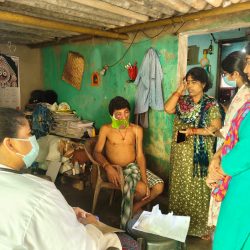
A doctor treats a patient in pain in Kerala, India.

It is clear that we live in a world where inequities of healthcare are paramount: there are millions dying of AIDS in Sub-Saharan Africa for want of drug therapy, while expensive surgeries for cancer, heart disease, or even to repair an injury like mine is out of reach for the world’s poor.

But what of the inexpensive palliative measures for those experiencing pain? I don’t have to dig very deep in my memory to pull up countless images of people I’ve witnessed in excruciating, seemingly never-ending agony. In Cambodia I came across a man who had lost half of his arm clearing mines, and hours later at a health clinic, he still hadn’t received so much as a Tylenol.

Read the rest of this article here…

Commenting on the article, Alierias from Airville, Pennsylvania says:

“My heart bleeds for those who don’t have that option”

Dear Alierias, thank you for your compassion. Your heart is going to be very busy. It is going to have to bleed for an unbelievable 5 billions – 80% of the global population that have no access to effective pain relief.

What make it worse, are the opportunists who try to cash in on the pain, making sure that cheap effective opioids are not available, but that very expensive ones are.

Watch out for the “Morphine Manifesto” that global organizations are bringing out together on World Cancer Day, the 4th of February 2012, demanding access to simple inexpensive opioids before making expensive alternatives available.

In the meantime, dear Josh Ruxin, Alierias and all others who have that spark inside them demanding justice for those in pain, please keep the fire in your belly burning. We in developing countries need your help.

-

Thank you Meg O’Brien of Global Access to Pain Relief Initiative (GAPRI) for bringing this to our attention.

New CEO for Pallium India

2012 January 24
Comments Off

We are glad to report that a volunteer-trustee of Pallium India, V Jayaprakasan has taken over as the Chief Executive Officer of Pallium India.

Dr V Jayaprakasan (right) is a retired Professor and Dean of Veterinary Sciences of the Kerala Agricultural University.

He came across palliative care when his dear wife Sushama got cancer of the pancreas.  She is no more now, and his work in Palliative Care is the Taj Mahal that Jayaprakasan (JP as he is fondly called by the team) has built for the departed Sushama.

Welcome, JP, and thank you for all that you are doing for people in pain and suffering.