
What Rani Needed: Listening. Staying. Being.
Sometimes, what a person needs most is not another prescription or another investigation. It is someone who will sit with them, listen to their fears and help them find the courage to take the next step.
Rani is just 42. Like many women, she has spent much of her life looking after others. She too, has responsibilities to shoulder, difficulties to overcome and very little time to think about her own needs. When she came into contact with Pallium India, she was already receiving care for chronic low back pain. But there was something else that needed attention.
In March 2026, she was referred to our Palliative Care Dentistry (PCD) team with a painful ulcer on the left side of her tongue that had refused to heal.
She had visited several local dental clinics. The ulcer had been treated as a possible vitamin deficiency, but the pain persisted. At Government Dental College, Thiruvananthapuram, a biopsy was advised.
But Rani was afraid.
It was not just the biopsy that frightened her. She worried about the cost of further investigations and what might follow if something serious was found. She had a family to look after and responsibilities she could not simply set aside. The possibility of a serious illness was frightening, especially when she did not know what lay ahead or whether she could afford the treatment.
Perhaps, like many people in similar circumstances, she wondered whether it was better not to know.
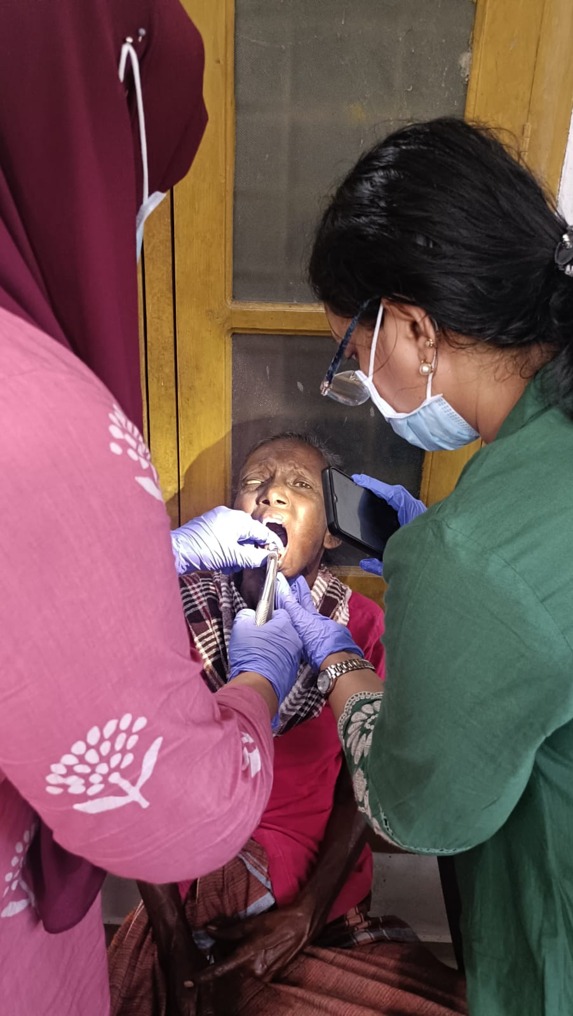
The PCD team realised that simply advising a biopsy would not be enough. Rani needed time. She needed someone to understand why she was hesitant, rather than simply tell her what she should do.
There were conversations, explanations and repeated counselling sessions. Her fears were listened to, her questions answered, and the importance of finding out what the ulcer really was gently explained. The team did not rush her. Slowly, trust grew, and so did her willingness to seek answers.
Eventually, Rani agreed.
On 23 April 2026, she underwent an incisional biopsy at Government Dental College, Thiruvananthapuram. The result revealed well-differentiated squamous cell carcinoma of the tongue.
It was difficult news, but it also meant that she could now access the treatment she needed. She was referred to the Regional Cancer Centre (RCC), Thiruvananthapuram. On 29 May 2026, she underwent surgery, including left wide excision and selective neck dissection, followed by primary closure. She subsequently completed 30 fractions of radiotherapy on 14 August 2026.
Today, she continues to receive care from Pallium India for pain relief and supportive care, including morphine.
There was so much more to Rani’s life than her illness.
Rani is a mother of two boys. Her husband had left the family when the children were young and returned two years ago. Just four months after his return, he developed one-sided weakness while working at sea. He could not return for ten days and was eventually hospitalised. With treatment and rehabilitation, he has regained some mobility and can now walk with assistance.
Rani’s mother is also bedbound. Through all this, Rani has been the primary caregiver for both her mother and her husband. She now lives with her sister and family.
Consider what this means for a 42-year-old woman. She has her own pain, a cancer diagnosis, two children who need their mother, a husband recovering from a disabling illness and a mother who depends on her. Even when she is unwell, life does not pause to give her time to recover.
For Rani, deciding to undergo a biopsy was not simply a medical decision. It meant confronting the possibility of cancer, worrying about money and wondering how her family would manage.
Perhaps this is what we sometimes fail to see when we meet patients in our clinics. Behind every missed appointment, delayed investigation or hesitant response, there may be a story of fear, financial hardship and responsibilities that we know very little about.
A few words that stayed with us
During a recent visit, Rani introduced the Palliative Care Dentistry team to her sister. Then, with a warmth that was difficult to miss, she said:
“Do you remember? My son Rahul often talks about a doctor who saved my life. This is that doctor.”
We were deeply moved.
For Rani’s son, the doctor was not simply someone who had examined his mother or referred her for a biopsy. She was someone who had helped his mother when she was frightened, someone who had encouraged her when she could not see a way forward.
We may remember the clinical details: the persistent ulcer, the biopsy, the diagnosis, the surgery and the radiotherapy. But Rani’s family remembered something different. They remembered that someone cared enough to listen, to return, to explain and to not give up on her when she was hesitant.
We cannot say that one conversation saved Rani’s life. Nor was the journey made possible by one person alone. It involved the efforts of several teams and healthcare professionals. But we can say that being heard and supported helped her take an important step towards diagnosis and treatment.
What Rani reminds us
Her story is a reminder that palliative care is not only about relieving pain. It is also about recognising the fears that patients carry, understanding the circumstances in which they make decisions and helping them access the care they deserve.
The Palliative Care Dentistry team’s contribution was not to diagnose or treat her cancer. It was to recognise that a persistent oral ulcer needed further evaluation, understand what was holding her back and support her in reaching the right place for diagnosis and treatment.
Palliative care does not mean giving up on cure. It means never giving up on the person, whatever the diagnosis may be. It means relieving suffering, supporting families and helping people find a way forward, even when life feels overwhelming.
We often measure our work through the number of patients seen, procedures performed and services delivered. But occasionally, a few simple words remind us of something far more important.
“This is that doctor.”
Perhaps that is one of the most beautiful things a healthcare professional can hear. Not because we have done something extraordinary, but because, at a difficult moment in someone’s life, we were there when they needed us.
And sometimes, that is where healing begins.
– Dr Amirtha Thampi
Head – Palliative Care Dentistry
Pallium India