
Where Care Calls Us: Thiruvonam@TIPS IP
Thiruvonam has always carried a certain feeling with it. Across Kerala, homes wake up a little differently. There is a pookkalam at the entrance, the smell of a Sadya coming from inside, people moving around in their best clothes, relatives calling and visiting, and that very familiar feeling that Onam is, above everything else, about being together.
But in a hospice, Thiruvonam can look a little different. Our care beneficiaries and their caregivers were here. So were our doctors, nurses, care assistants, social workers and other staff who were on duty. While most people were celebrating at home, our day continued much like any other day at the Inpatient Unit in the Trivandrum Institute of Palliative Sciences (TIPS). There were medications to be administered, care to be provided, families to be supported, and all the little things that have to keep moving even on a festival day.
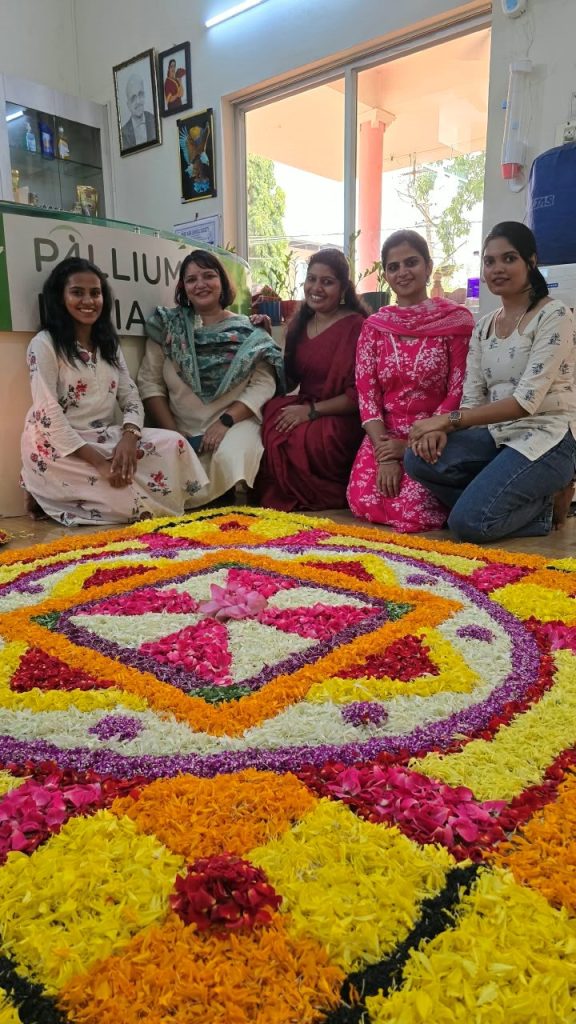
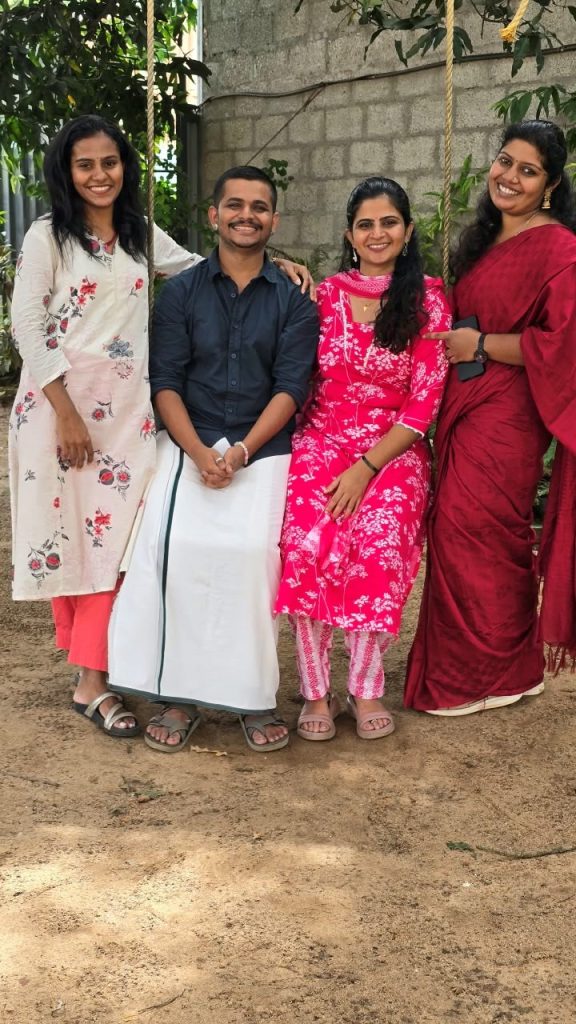
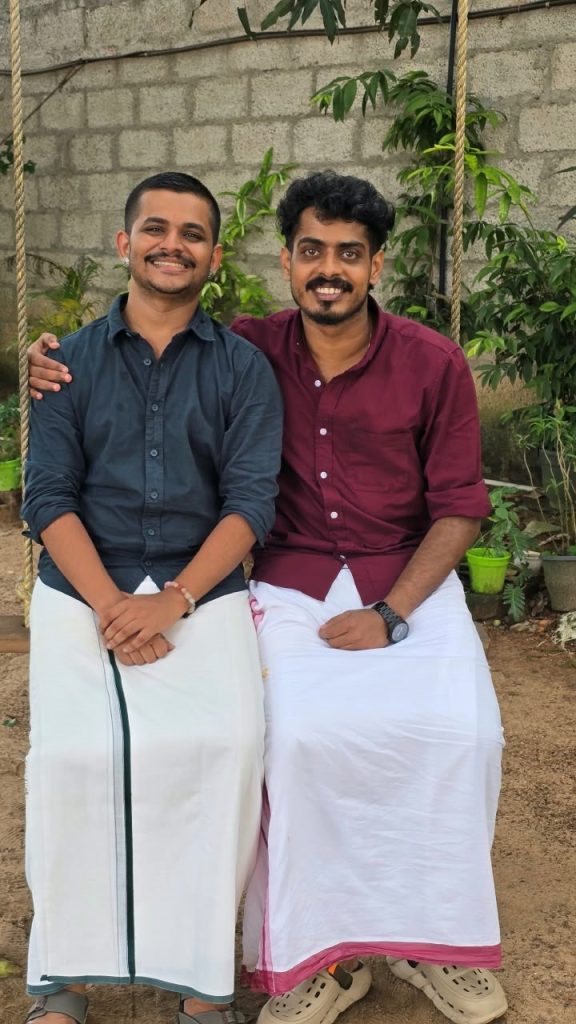
On the morning of Thiruvonam, the pookkalam became an immediate priority. We had the flowers, and we had the space, but what we did not have was a design. There was no carefully drawn pattern waiting for us, no elaborate plan and certainly no time to sit and work one out. So, we simply started. The pookkalam came together one layer at a time, with James, the Section Head of Physiotherapy, and SO Angel somehow becoming the eyes of the whole thing. We would put down a layer, step back, look at it, decide what was missing and add another. There were moments when none of us was quite sure what the final thing was going to look like. We just kept going, trusting the colours, the shapes and, mostly, James and Angel’s instinct for where each flower needed to go. By the end, we had a pookkalam without a predetermined design, but one that had somehow come together through teamwork, instinct and participation.
It was not perfect, and it did not need to be. It was not something created for display or competition. It was simply ours, and perhaps that made it even more appropriate for the day.
The same spirit carried through the rest of the celebration. I think the IP team who were on duty that day deserve a special round of applause. There was so much participation from everyone, and what I appreciated most was that nobody allowed the celebration to become a reason for the work of the unit to suffer. They were there for the pookkalam, for the laughter and for the little festive moments. They participated whenever they could, but they also made sure that their duties were never missed.
That balance is important in a place like this. We cannot simply close the doors because it is Onam. The care beneficiaries still need their medicines. Someone still needs assistance. Someone may need help to sit up. A caregiver may need reassurance. A doctor may need to review someone. A care assistant still has to do what a care assistant does. The celebration has to find its place within care, not instead of it, and the IP team managed that beautifully. They made space for joy without compromising responsibility, and that, to me, was one of the most important parts of the day.
One of the things I was particularly happy about was that we did not let the limitations of the hospice environment decide who could participate in the Sadya. A traditional Onam Sadya assumes that everyone will gather around a table or on the floor, but not everyone in our hospice could make their way to a common dining space. So instead of expecting our care beneficiaries and caregivers to come to the Sadya, we took the Sadya to them.
We brought the meal down to the ground floor of the hospice, where people were already settled and where those with limited mobility could take part without the additional effort of being moved elsewhere. Even that required some improvisation. At times, we had to use cardiac tables as dining tables, carefully placing banana leaves on them so that our care beneficiaries could have the Sadya the way an Onam Sadya is meant to be had. There was something very moving about that sight: a banana leaf resting on a cardiac table, a traditional Sadya being served in a hospice, someone eating slowly because of pain, a caregiver sitting beside them, and staff moving around to help where necessary.
It was not the picture of an Onam that we usually imagine. But it was ours.
Perhaps this is where palliative care changes the way we look at even the simplest things. A Sadya is not just a meal. For many people, it is a symbol of participation. It says that you are part of this, that you belong at this gathering and that there is a place for you. For someone who cannot sit at a conventional table, taking the Sadya to them becomes more than serving food. It becomes a way of making sure that their illness does not completely separate them from something as ordinary and joyful as Onam.
The celebration itself was intimate. There were no grand arrangements and no elaborate programme that needed to be followed from beginning to end. There was the pookkalam that appeared almost magically from a pile of flowers, a Sadya served on banana leaves, laughter between responsibilities, conversations that lingered a little longer than usual, and people taking a few moments to simply enjoy being together. There were care beneficiaries and caregivers who got to experience a little bit of Onam without leaving the hospice, and there was the quiet happiness that comes when people simply decide to make a day special for each other.
But, as is always the case in a hospice, the happiness existed alongside something else. Pain was there. Disease was there. And death was there too.
We had lost care beneficiaries in the previous couple of nights. That kind of loss does not disappear simply because it is a festival day. The beds where people had been sleeping were now empty. Families who had spent days or weeks with us had gone home without the person they had come with. Conversations from the previous day remained in our minds. Somewhere in the middle of a pookkalam or a Sadya, there would be that brief awareness that someone who had been part of our everyday lives was no longer here.
This is perhaps one of the hardest and most beautiful things about life in a hospice. Joy and grief are not neatly separated. They exist together. We can laugh and still miss someone. We can celebrate and still grieve. We can enjoy a Sadya and still be aware of how fragile life is. There was something very honest about our Thiruvonam because we did not try to hide that reality. We did not pretend that it was a normal Onam at home. It was Onam in a hospice, and that meant celebrating with the reality of illness and loss sitting quietly beside us.
Yet the happiness was real, and I think it mattered. Palliative care is not only about what we do when things are difficult. It is also about making sure that difficult circumstances do not take away every possible moment of living. A person may be in pain and still want to see a pookkalam. A caregiver may be exhausted and still want to share a meal. Someone who has spent days in a hospital bed may still want to eat a little of their favourite Sadya items from a banana leaf. These may seem like very small things, but in the context of serious illness, small things are often not small at all.
Looking back, that is what I will probably remember most about this Thiruvonam.
That contrast is difficult to explain to someone who has never worked in palliative care. But perhaps it is also what makes days like this so meaningful. Joy does not have to wait until grief has passed. Life does not stop simply because death is present. Sometimes, celebrating is itself a way of affirming the life that is still here.
At TIPS, care does not take a holiday. But that does not mean joy has to take one either.
Sometimes, Onam is not about being at home with your own family. Sometimes, it is about creating a little home wherever you are, with the people beside you and with the people who make that place feel like home. For one day, the hospice became a little more like that. There was no attempt to make it something it was not. We simply made the space a little brighter, the food a little more festive, the day a little happier and, perhaps most importantly, made sure that nobody had to miss out simply because they were unable to leave their bed.
As my first Thiruvonam as the IP In-charge Social Officer, that is what I will carry with me. That celebrations do not always need elaborate plans. That sometimes the best pookkalam is the one made one layer at a time. That sometimes a cardiac table can become an Onam dining table. That sometimes celebrating means making sure someone else gets to be part of the celebration. And that, in a hospice, being there for people is sometimes the most meaningful way of celebrating at all.
While the world celebrates at home, we celebrate where care calls us.
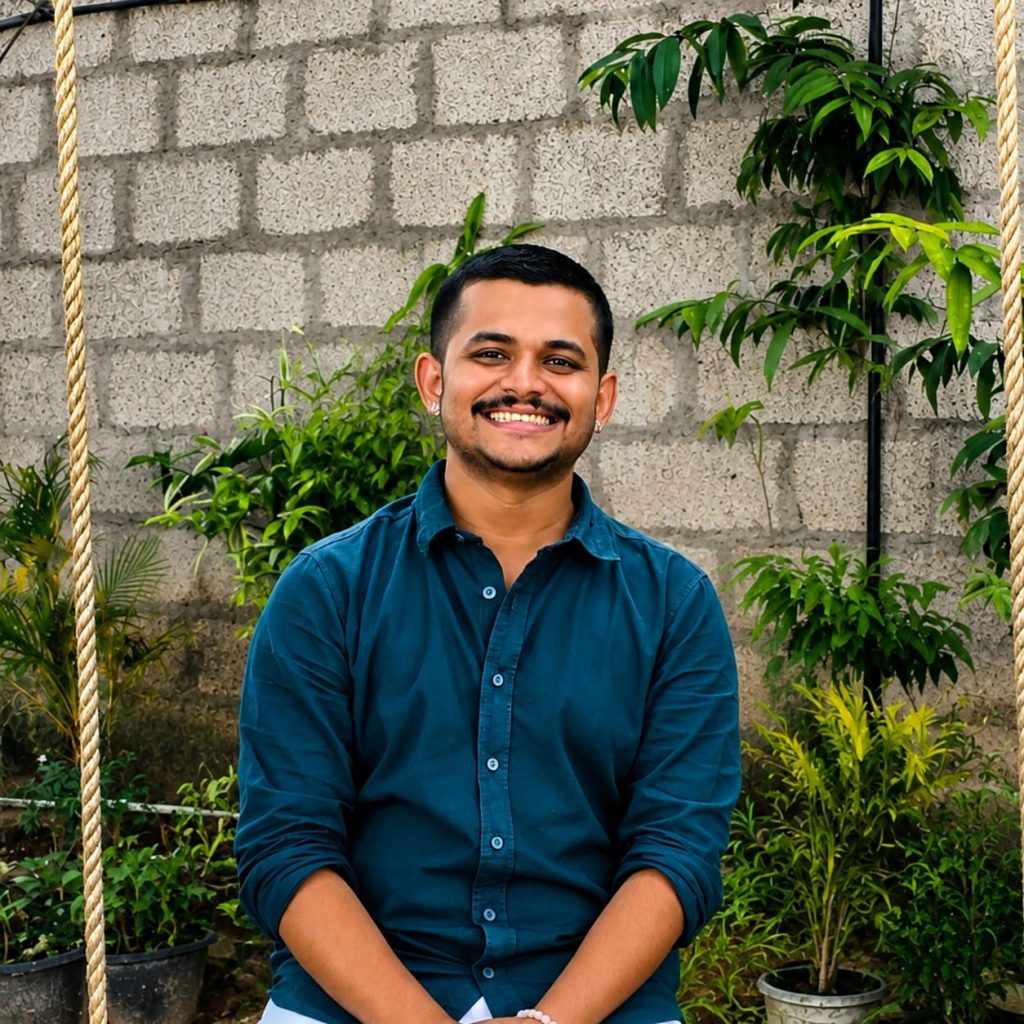
Gokul K Gopikrishna
TIPS IP In-charge Social Officer, Pallium India